It is becoming increasingly common to see cows without horns in the fields or mountains. If you ask farmers, they will tell you that it is more convenient, that at least they do not get hurt….
But what is the reality behind dehorning? What are the consequences for animals and humans?
In nature everything exists for a good reason. Nothing is useless.
The cow horns are therefore not decorative but rather functional.
They form slowly, from year to year according to the animal’s rhythm. They are an extension of its body, a functional outgrowth, an organ that has become a form. They are essential to the animal’s vital, psychological, and energetic balance.
The horn is an energy organ that has its very own raison d’être.
Moreover, biodynamic agriculture is no stranger to this concept. Inspired by Rudolf Steiner’s work, the cow horn is used to store and activate natural substances, capture cosmic-terrestrial forces, and restore structured energy to the Earth. It is often considered a “true natural alchemical chamber”.
-Preparation 500 is cow dung buried in a horn during the winter and placed in the ground. It will stimulate microbial life, strengthen the structure of the soil, promote root development, and reconnect the soil to the forces of the earth.
-Preparation 501: finely ground silica, placed in a horn and buried during the summer. This strengthens the plant-light relationship, improves photosynthesis, structures aerial growth, promotes maturation and quality.
During his conference on June 12, 1924, Steiner taught how to prepare the best manure: «Having buried the cow horn filled with manure, we retain in it the forces that the cow horn used to exert within the cow itself, namely to reflect the etheric and astral.» «[The horn being] surrounded by earth, all the rays that go in the direction of etherization and astralization converge and penetrate the cavity that it forms» *
In biodynamics, it is believed that the horn structures the information contained in the dung or silica, amplifies the living potential and enables a subtle maturation that is impossible in a neutral container. Farmers in biodynamics do not consider the horn as a fertilizer but as a life stimulator.
Claude and Lydia Bourguignon, two great specialists in soil microbiology, observe: «Without being able to explain it, the biological activity of the soil increases deep down with horn dung. This is like witchcraft; yet the result is there: the composts evolve faster, the microfauna and trace elements are more numerous, the soil is better aerated and the roots are deeper.».
Its use is based on the idea that certain forms derived from living things are capable of structuring and transmitting information beyond mere matter. This is thus a disturbing empirical observation that prompts us to question the ability of certain forms derived from living things to structure and transmit information beyond their mere material composition.
But that’s not all.
The cow’s horn is a living extension of the living being; it is a form born from the body that continues to act as a mediator between nature and humankind.
It is part of a sacred geometry embodied in life. Its growth forms a spiral curve that evokes certain forms of proportional growth observed in life, notably the logarithmic spiral.
The spiral shape of the horn (quite similar to many sacred symbols such as the vortex, the cosmic spiral, the kundalini,...) will capture the terrestrial energies, the cosmic energies and will make these forces circulate again. How?
Thanks to its spiral shape, which plays an essential role: it slows down, organizes, and redistributes the flow of matter within it. Associated with a conical structure and a central axis, it creates a movement of concentration and diffusion, comparable to a natural distillation process.
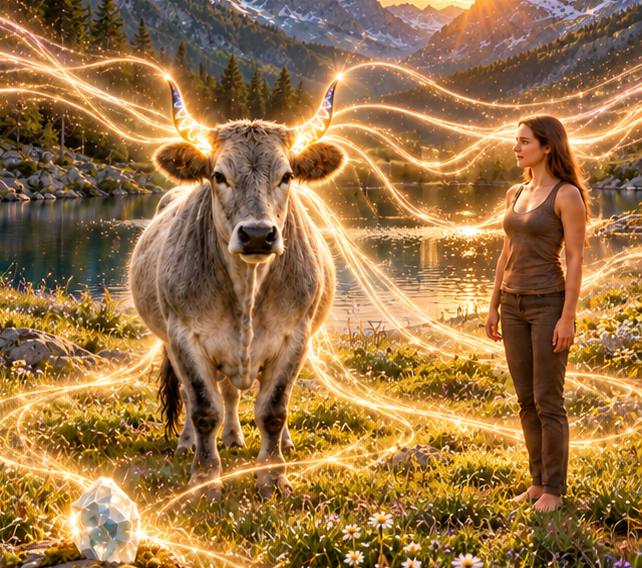
The horn is a living antenna that connects the sky, the Earth, and human beings. It allows the cow to receive the invisible cosmic and terrestrial energies for the human eye, to “filter” these energies, and to redistribute them. It is an organ for the circulation of subtle forces, but also an energy regulator. By catalyzing the forces of Nature that are imperceptible to humans, it transforms them so that they can be beneficial to humans and not harmful. Its spiral shape and its living nature thus allow it to metabolize energies from Nature that can be too raw and too intense. It transforms them and makes them assimilable by the human being.
It is therefore a mediator between the invisible and the visible.
If we now observe the animal from the perspective of a living being:
When a cow is dehorned, this energy is no longer transformed.
It will tend to stagnate in the animal’s head and it can no longer be redistributed on Earth. This will result in pain for it. It is reasonable to think that this can cause severe headaches for it. Similarly, some observers have noticed an increase in its sensitivity to stress.
The cow is an animal that lives in groups and has social relationships with its peers. Within its herd, communication becomes much more blurred, because the cow also uses its horn as a social instrument to signal hierarchy, defuse conflicts without violence, express her discontent, her submission, her curiosity, … The dehorned cow will therefore be more reactive and much less relaxed. Therefore, the horn also acts as a balancer of her emotional field.
The horn must be considered a living sacred geometry: not an ideal figure frozen in time, but an embodied, evolving form, bearing memory and transformation. It stands at the boundary between the invisible and the visible, between strength and softness, reminding us that life does not merely produce, but metabolizes, connects, and humanizes.
Knowing this, and understanding all the implications, it becomes necessary to encourage farmers to leave the horns on their cows.
*https://www.agriculture-environnement.fr/2010/09/23/agriculture-bio-les-forces-cosmiques-de-la-biodynamie
*https://magazine.laruchequiditoui.fr/le-secret-de-la-corne-de-bouse-et-autres-subtilites-de-lagriculture-biodynamique/